
Short history of Russian eggs
The use of colored eggs also has deep roots going deep to the past centuries. This tradition was known in China, in Ancient Greece and in Rome. In the ancient language of Egyptian hieroglyphs the determinative sign of an egg  displays a certain potential, a life-giving seed, a mystery of being. As for the Orthodox Easter traditions, the colored egg has always been one of the main symbols of Easter. There are two types of Easter eggs mostly used in Russia: "pisanki" ? richly ornamented eggs of two, three or four colors, and "krashenki" ? Easter eggs of one color, without any ornament. In compliance with ancient traditions Russians mark the celebration of Easter with presenting colored eggs to each other.
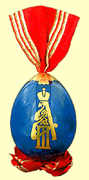 This tradition was also very popular with the Russian ruling house; the colored eggs were presented to boyars and Russian nobility. In addition to natural eggs, there were extensively used eggs made of different materials and richly ornamented.
By the beginning of the 20th century Easter eggs making had turned to be an independent branch of Russian decorative and applied arts. A special place is occupied by porcelain eggs, which were specially ordered by the Russian Tsars at the Emperor Porcelain Manufacture. They are of high artistic value and perfection and are viewed at present as popular antique objects and Russian souvenirs.
At present time decorated eggs are made of wood and then painted with different topics, of crystal and glass materials then enraved and painted with gold paints, of metal, stones, porcelain. The topics fo painting can be different - floral motives, Easter scenes, portraits, animals, architecture, landscapes and many more.